

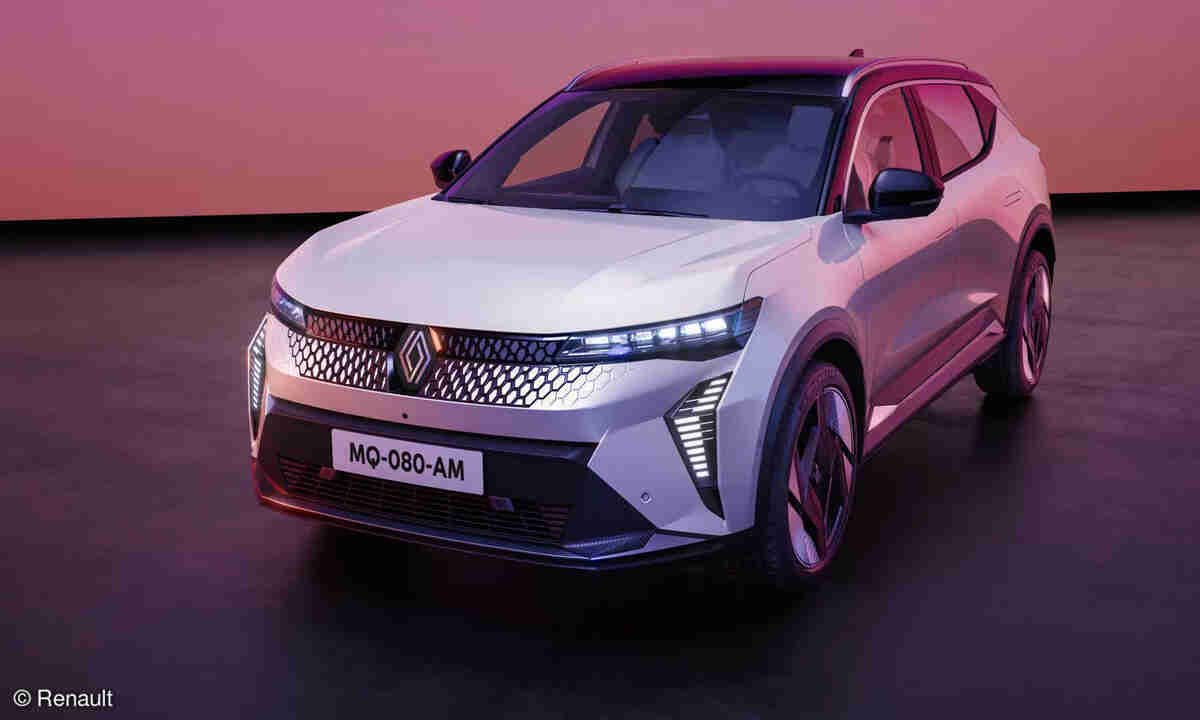
The Renault Scenic E-Tech marks a bold reinvention of a nameplate that once defined the family MPV. Today it’s an elegant, highly efficient electric crossover that blends long range, roomy practicality and smart tech — without the bulk of a full-size SUV. Whether you’re researching an EV for family life, commuting or longer trips, the Scenic E-Tech deserves attention. In this long-form guide I’ll walk you through what it is, the trim and battery choices, real-world performance, interior comfort, charging and tech, safety, pricing and who it’s best suited for — plus a tidy spec table you can skim. (SEO note: this post uses clear subheads, user-friendly bullets and a specs table to make it easy to scan and share.)

Quick summary (TL;DR)
- The Scenic E-Tech is Renault’s mid-size electric crossover built on the Renault–Nissan CMF-EV / AmpR platform and positioned as a roomy, efficient family EV.
- It’s offered with two main battery / power options: a 60 kWh (approx.) pack with ~430–420 km WLTP range and a 87 kWh long-range pack delivering up to ~600+ km WLTP, depending on trim. Power outputs are roughly 125 kW (170 hp) for the standard pack and 160 kW (220 hp) for the long-range variant.
- Practical interior, big boot (flexible load space up to around 1,400–1,670 L with seats folded), modern OpenR Link infotainment with Google built-in, and advanced ADAS make it family-friendly. renault.co.uk+1
Design & exterior — modern, tidy, functional
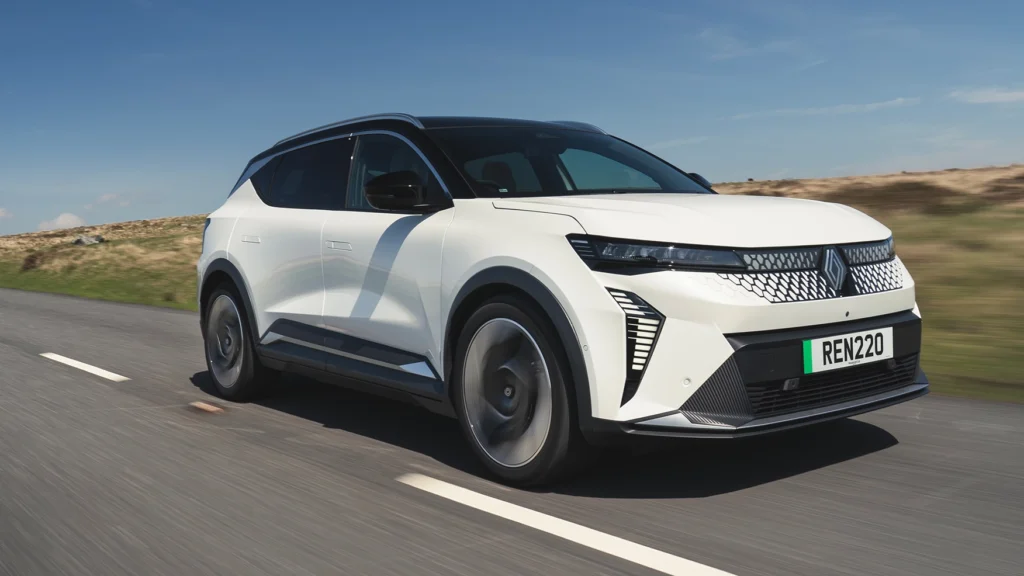
Renault gave the Scenic a directional redesign that sits between an SUV and a crossover hatchback. The silhouette is compact (around 4.47 m length), but the body is sculpted with a broad shoulder line, slim LED lights and an upscale front grille treatment that houses the new Renault badge. The overall look is contemporary without being overly aggressive — designed to appeal to buyers who want presence without the height and bulk of large SUVs. Many reviewers praise the design for feeling premium at the price point.
Practical touches include an available SolarBay panoramic roof (adds light and a premium feel) and aerodynamic wheels tuned for efficiency. The charging port location and bumper design are typical for modern EVs: neat, purposeful and easy to use.
Powertrains, battery choices & claimed range
One of the Scenic’s headline features is its range: Renault offers two main powertrain choices to suit different buyers.
- Standard (EV60) — ~60 kWh usable battery: produces roughly 125 kW (170 hp) and ~280 Nm torque. WLTP range figures are in the ~420–430 km ballpark depending on configuration. This version is aimed at buyers prioritising value and typical daily driving with occasional long trips.
- Long-range (EV87) — 87 kWh usable battery: produces roughly 160 kW (220 hp) and ~300 Nm torque with WLTP ranges quoted up to ~600+ km (around 625 km WLTP in some configurations) — a standout figure for a mid-size EV and a major selling point. Real-world range tends to be lower depending on speed, weather and load; independent testers report around 450–480 km real-world for the 87 kWh in mixed driving.
Rapid charging capability is competitive: the Scenic accepts DC fast charging (up to around 150 kW on the EV87 in many markets), which helps reduce downtime on long trips. AC on-board charging support varies by market and trim (Renault advertises up to 11 kW / some materials reference 22 kW AC capability).
Performance & driving impressions
With the long-range 160 kW motor the Scenic is brisk off the line — 0–100 km/h in roughly 7.9 s is a typical quoted figure — while the standard 125 kW unit delivers adequate acceleration for everyday use. Top speed is electronically limited at around 170–190 km/h depending on market spec. Most road testers say the Scenic favors comfort and efficiency over sporty handling; it’s composed and easy to drive, but not a drivers’ car. That’s fine — the target audience is families and commuters who want an efficient, comfortable EV.
Interior, space and practicality
Renault leaned into the Scenic name’s heritage — which historically emphasized interior space and family usability — by delivering a roomy cabin with good rear-seat legroom and a flat floor (thanks to the skateboard EV architecture). The dashboard is clean and dominated by the OpenR Link infotainment system with Google services built-in (Apple CarPlay and Android Auto options vary by market). Materials feel modern and the overall fit and finish in higher trims is noticeably improved over older Renaults.
Boot capacity is generous for the segment, and folding the rear bench opens up a surprisingly large cargo area (Renault quotes up to around 1,449–1,670 L depending on how you measure and the seat configuration). Rear armrests, practical storage compartments, and family-friendly touches like ISOFIX and multiple USB charging points are present.
Tech & connectivity
OpenR Link multimedia integrates Google services and an upgraded UI; Renault also highlights “continuous upgrades” to the system for new features over time. The scenic supports connected services such as predictive maintenance, remote vehicle control (via app), and OTA updates in many markets. A head-up display, large central touchscreen (often 12″+ depending on trim), digital instrument cluster and a quality audio system (Arkamys Auditorium on some trims) round out the tech package.
Safety & ADAS
Renault equips the Scenic with a broad set of driver assistance systems: adaptive cruise control with stop-and-go, lane centring, automatic emergency braking, blind-spot warning and intervention, rear cross-traffic alert, traffic sign recognition, 360-degree camera and parking assistance features on higher trims. Newer updates also add driver fatigue detection and camera-based customization of driver settings. Expect solid safety scores in independent testing, though final ratings can vary by market/spec.
Charging: home and fast charging
- AC charging: Home charging using a wallbox is straightforward; Renault advertises on-board AC charging up to 11 kW on many versions and some markets/specs mention up to 22 kW capability. That means overnight full charges at home are realistic for both battery sizes.
- DC fast charging: Up to ~150 kW on the EV87 long-range variant, enabling fast 10–80% sessions in competitive times (actual charge speed depends on battery temperature, state of charge and charger). For long trips, the 87 kWh pack’s higher usable capacity plus faster charging makes highway travel more convenient.
Trim levels & pricing (what to expect)
Pricing varies significantly by country, incentives and trim. In the UK, for example, Renault lists a starting price in the mid-£30k region for the Techno trim (which is often the entry into the battery lineup), while long-range versions and higher trims move into the high-£30k to low-£40k bracket. Across Europe, pricing and included features will differ, and purchase/leasing deals change frequently. Always check local Renault websites or dealers for exact, up-to-date pricing.
Who should buy the Renault Scenic E-Tech?
Buy it if:
- You want a practical family EV with lots of interior space and a sensible driving range.
- You value real-world range and low running costs — the 87 kWh variant is excellent if you do longer journeys frequently.
- You like modern tech, Google-integrated infotainment and a comfortable, efficient ride.
Skip it if:
- You want a sporty, dynamic handling car — the Scenic emphasizes efficiency and comfort over sharp sporty dynamics.
- You need towing capacity or a heavy-duty SUV footprint — this is a mid-size crossover focused on everyday family use.
Detailed specs table
| Item | EV60 (Standard) | EV87 (Long Range) |
|---|---|---|
| Usable battery capacity | ~60 kWh | 87 kWh |
| Motor power | ~125 kW (170 hp) | 160 kW (220 hp) |
| Torque | ~280 Nm | ~300 Nm |
| Drive | FWD | FWD |
| WLTP range (quoted) | ~420–430 km | up to ~600–625 km |
| Real-world range (typical reported) | ~350–420 km | ~450–480 km (varies) |
| 0–100 km/h | ~8.5–9.0 s (approx) | ~7.9 s |
| Top speed | ~170 km/h | ~170–185 km/h |
| DC fast charging peak | up to ~100 kW (varies) | up to ~150 kW |
| AC onboard charging | up to 11 kW (some specs 22 kW) | up to 11 kW (market dependent) |
| Boot / cargo (max) | ~1,400–1,670 L (seats down, market measure varies) | same |
| Typical kerb weight | ~1,850–1,900 kg | ~1,850–1,900 kg |
| Key features | OpenR Link infotainment, family storage, ADAS suite | As above + longer range, faster charging |
| Sources | Renault / EVdb / press reviews. | Renault / EVdb / press reviews. |
Notes: WLTP and real-world figures vary by market, trim, wheel size and driving conditions. Always check local Renault specs for exact numbers and the specific configuration you’re considering.
Real-world ownership: costs, warranty and running
Electric ownership economics depend on electricity price, charging habits and incentives. In many European markets Renault offers warranties on battery health (often 8 years / 160,000 km for a certain retained capacity — check local terms). Maintenance costs are typically lower than ICE cars (fewer moving parts), but tyre and brake wear, insurance and charging infrastructure access are important cost factors. Renault also provides connected services and maintenance packages to smooth ownership. renault.co.uk+1
Competitors — how the Scenic stacks up
In the mid-size, family-oriented EV segment the Scenic competes with models like the Kia EV6 / EV3 family offerings, Hyundai Ioniq 5/7 variants, Volkswagen ID.4/ID.5 depending on configuration, and various Chinese OEM entries that are expanding in Europe. The Scenic’s strengths are range efficiency (especially the 87 kWh model), interior space and price/value ratio in many markets. If you prioritise sportiness or a particular brand ecosystem, one of the competitors may suit you better — but the Scenic is compelling if you want a practical, long-range family EV at a competitive price.
Pros & Cons — quick list
Pros
- Class-leading long-range option (87 kWh delivering great WLTP figures). EV Database
- Spacious, family-friendly interior with modern infotainment. renault.co.uk+1
- Competitive pricing for the features offered. renault.co.uk
Cons
- Handling is comfortable but not sporty — enthusiasts may prefer sharper rivals.
- Visibility and certain trim-dependent fitments were noted as “only okay” by some reviewers.
Final verdict
The Renault Scenic E-Tech successfully reimagines the Scenic as a modern electric family car: roomy, efficient and packed with tech. The long-range 87 kWh variant is the headline grabber, delivering WLTP figures that make long journeys genuinely practical while the standard 60 kWh option offers a more affordable, still-capable alternative. If you want a comfortable, efficient family EV with a strong value proposition and the convenience of Renault’s connected tech, the Scenic E-Tech should be on your shortlist. Always test-drive your preferred trim, compare real-world range reports for the battery you want, and check local pricing and incentives.
Helpful links & sources
- Renault Scenic E-Tech official page (specs & trims).
- EV-Database — technical breakdown and real-world estimates
- Renault press & media releases — features and safety updates.
- Independent reviews (Carwow, Top Gear) for driving impressions and buying guidance.
